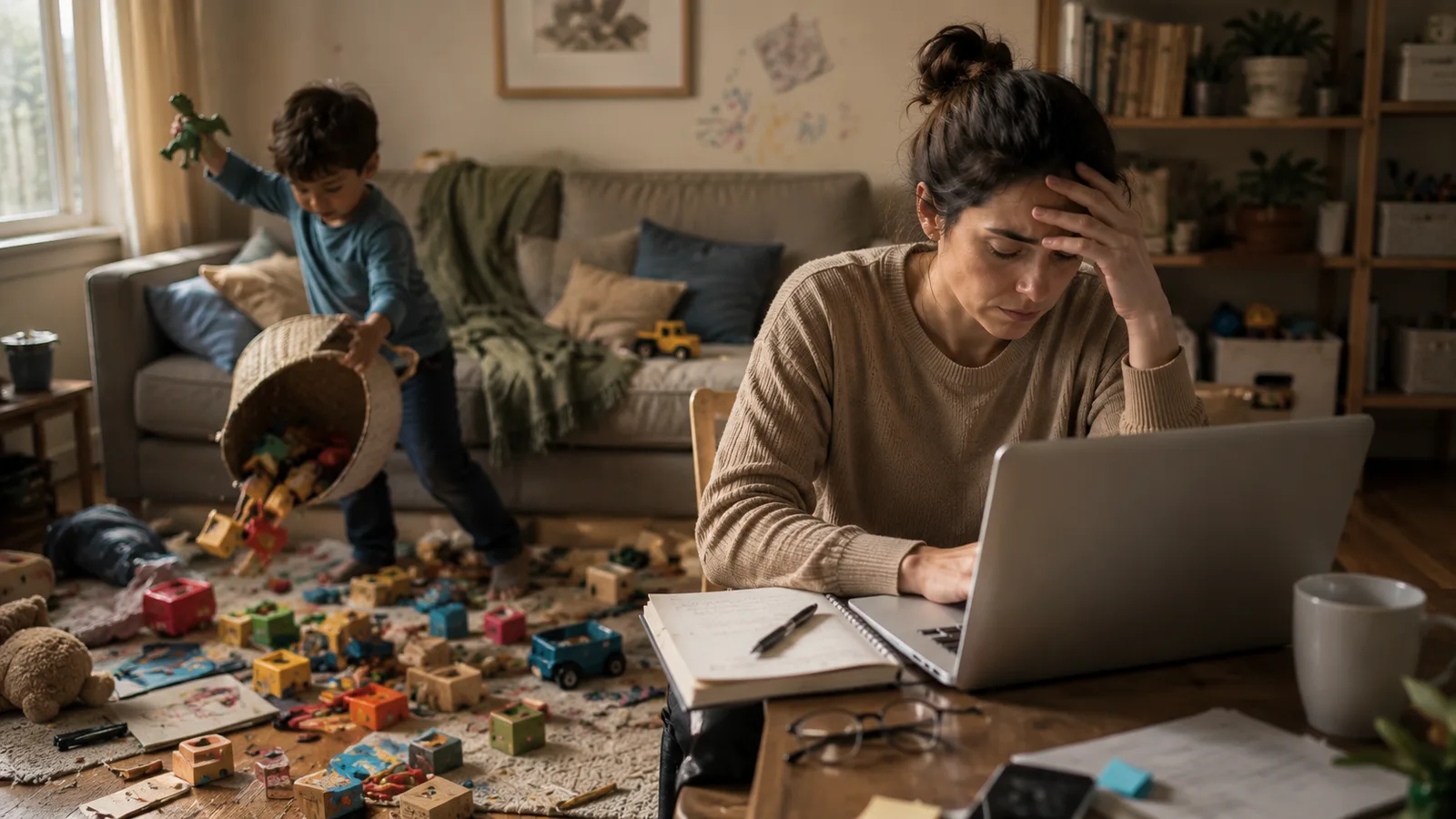
A recent study brought a figure that shouldn't be surprising, but is: 9 out of 10 Brazilian mothers show signs of parental burnout. Among the most frequent reports are constant guilt, a feeling of overload, emotional exhaustion, and difficulty balancing motherhood, work, and personal life.
The article published by Exame in May 2026, "The generation of exhausted mothers: the invisible impact of maternal performance on life and career," puts into words something I've been observing for years in consultations, lectures, and conversations with families: we have never had so many informed, conscious, and committed mothers. And perhaps never have so many lived with this permanent feeling of not doing enough.
You can read the full article here.
The problem isn't motherhood. It's what we've done with it.
There is a fundamental difference between caring and performing care. To care is a present, human, imperfect and sufficient act. To perform care is something else: it is the exhausting attempt to correspond to an ideal that doesn't exist, to always be present, always regulated, always productive, always patient, always available.
And when a mother comes to me exhausted, the problem is rarely that she cares too little. Almost always the problem is that she believes she still isn't doing enough.
This has a name. Winnicott called the "good enough mother" the one who doesn't need to be perfect. She needs to be real. But the culture we have built around contemporary motherhood seems to have completely forgotten what that means.
What neuroscience tells us about it
Prolonged states of overload have a real cost on the body and the brain. It is not weakness. It is physiology.
When a person remains in a constant state of hypervigilance, attentive to everything, responsible for everything, without space for rest without guilt, the nervous system pays the bill. Memory fragments. Sleep deteriorates. The capacity for emotional regulation decreases. And paradoxically, the very presence the mother so deeply wishes to offer her child becomes harder and harder.
Neuroscientist Lisa Mosconi researches specifically how the female brain responds to prolonged periods of accumulated emotional, cognitive, and hormonal demands. The results are striking: this accumulation crosses every sphere of life, including work, including relationships, including the capacity to be present with those one loves most.
The connection with the VELLA Method
This week I am in Orlando taking part in the Conscious Leader immersion, and one of the themes that most resonates with what I have been studying and living is exactly this: what happens when the adult who is supposed to be a child's emotional reference is, themselves, emotionally exhausted?
The VELLA Method begins from a principle that seems simple, but has deep implications: a child's development happens in relationship. And every relationship has two sides.
One of the pillars we work most with is secure bonding. And secure bonding is not synonymous with constant presence. It is synonymous with real presence. A mother who takes care of herself, who recognizes her limits, who asks for help and who doesn't blame herself for being human is, in practice, teaching her child something no self-help book can: that it is possible to exist in the world with dignity, with self-care, and with responsibility.
A child doesn't only learn from what the mother offers. They learn by observing the way this woman exists in the world.
This is also a corporate matter
The Exame article draws attention to something that rarely appears in productivity metrics: the invisible mental load that women silently sustain while still delivering results.
Companies that ignore this human dimension contribute to the illness of extremely competent professionals. And this has a cost: in turnover, in engagement, in climate, in talent retention.
When I talk about inclusion and belonging in organizations, I'm talking about exactly this: environments that recognize that behind every professional there is a whole human being, with a life, with caregiving responsibilities, with limits and needs that go beyond what appears in reports.
What I would like every mother to read here
You don't have to become ill to prove you love.
You don't have to erase yourself to be a good mother.
And resting is not selfishness: it is the condition for the love you have to give to actually reach those you love.
Human development doesn't begin in skills. It begins in relationship. And healthy relationships need two sides present, not just one exhausted side trying to sustain everything alone.
— Lilian Moura
Neuropsychopedagogue | Parenting Educator | Creator of the VELLA Method
lilianmouraneuro.com.br · contato@lilianmouraneuro.com.br