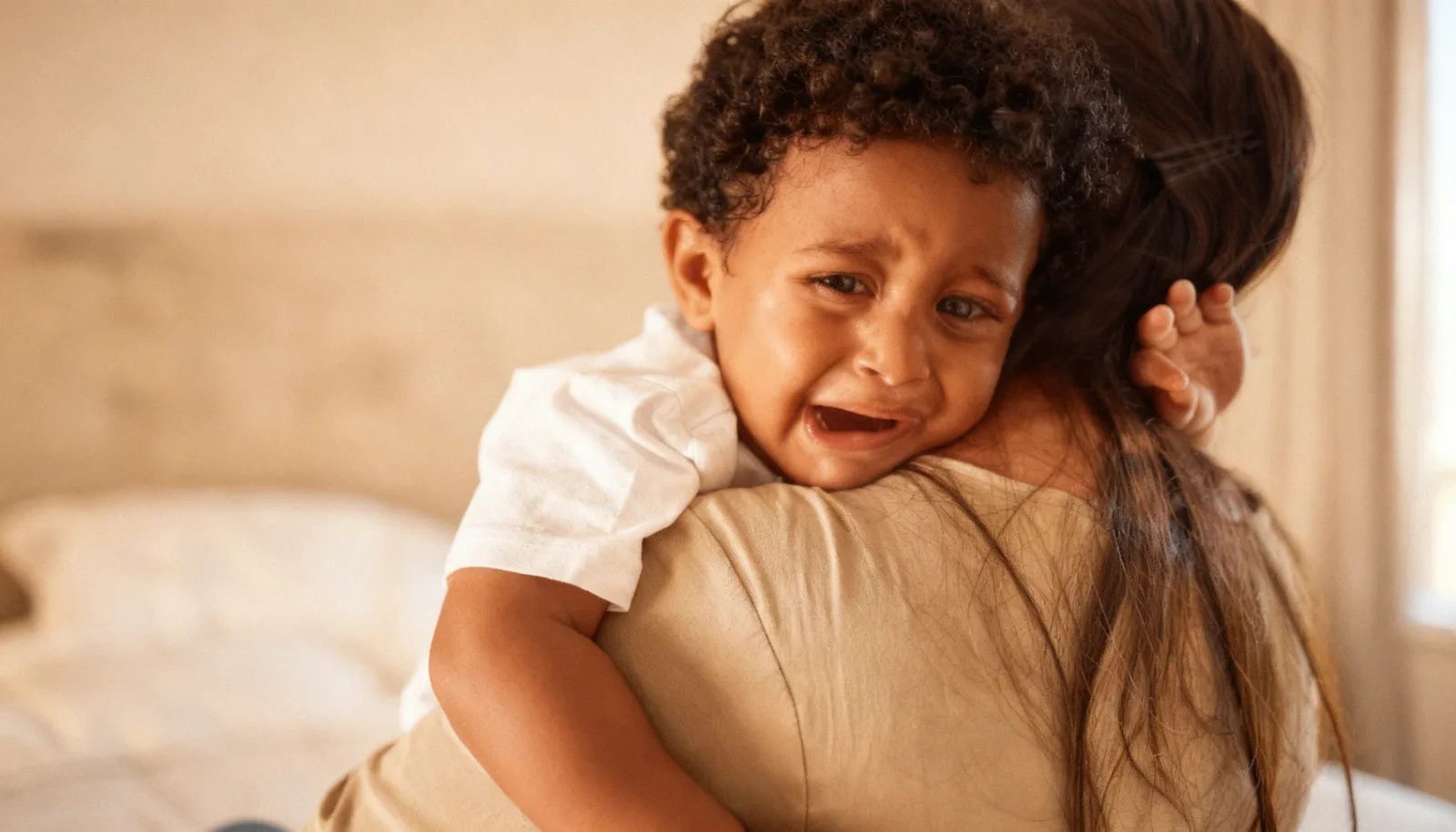
"Let him cry a little… otherwise he'll get spoiled."
This phrase still echoes in many homes. Sometimes spoken by a family member, sometimes only as a silent thought from someone trying to do the right thing.
But while the adult hesitates, the baby cries. And what is at stake in that moment goes far beyond the crying.
It's not about silence. It's about how that child's brain is beginning to organize itself.
The brain learns first through relationship
For a long time, it was believed that child development happened naturally, as if all it took was time passing. Today, neuroscience shows something different: a child's brain is built from the experiences they live, especially within relationships.
According to Daniel Siegel, the brain is a "social organ." Every interaction leaves a mark. When a baby cries and finds an adult who welcomes them, the baby is not just being comforted: they are living an experience that organizes their brain. Little by little, neural connections linked to safety, emotional regulation, and trust begin to strengthen. And this happens in a repeated, silent, everyday way.
A mother came to me worried because her son "only wanted to be held." When I observed the interaction, I realized he was seeking something deeper: predictability. Every time he cried and was attended to, his body relaxed quickly, not because he "got held," but because he found regulation.
The lap, in that case, was not excess. It was structure.
Safety is not a detail: it is a biological state
This understanding deepens when we look at polyvagal theory, developed by Stephen Porges.
A child's nervous system is constantly evaluating the environment. Even before thinking, the body asks: "Is it safe to be here?" When the answer is yes, the brain organizes itself. When it's no, it enters a defensive state. And for a small child, the absence of response, or harsh and disconnected responses, can also be perceived as a threat.
A common scene illustrates this clearly: a child in crisis at the supermarket, crying, body unorganized, unable to calm down. The adult, already embarrassed by the looks around them, says: "Stop that right now." But the child still doesn't know how to stop, because self-regulation isn't something a child arrives with already formed. It's something learned within relationship.
When, in a different context, that same adult comes close and calmly says: "I know you really wanted this… I am here with you," something changes. Not necessarily in immediate behavior, but in how the brain interprets that experience. The emotion stops being a risk. And becomes something that can be lived with support.
Children aren't born knowing how to self-regulate
One of the most common misunderstandings is to believe that a child needs to learn to calm themselves down early on. But self-regulation doesn't come out of nowhere. It is built, first in relationship, then internally.
It is the regulated adult who helps organize the child's nervous system. When the adult breathes deeply, kneels down, keeps a calm voice and says "I'm here," they are doing something much greater than soothing. They are teaching, without direct words, that it is possible to move through difficult emotions without losing safety.
Over time, this experience repeats so many times that it stops depending on the adult. It begins to exist within the child themselves.
It's not about always getting it right
Another point that causes a lot of anguish is the idea that everything must be done perfectly. But secure bonding doesn't come from perfection: it comes from consistency and, above all, from the ability to repair.
The studies of John Bowlby and Mary Ainsworth show that what sustains safety is the predictability of the relationship. This includes the moments when the adult fails. When, on a harder day, patience runs out and the tone of voice rises more than it should, what comes next is what really matters.
When the adult returns and says: "I spoke loudly and that may have scared you. Shall we try again?", they are not weakening the relationship. They are strengthening it. Because the child learns something fundamental: the relationship continues to be safe, even when it isn't perfect.
What is truly being built
When we talk about secure bonding, we are not just talking about welcoming or affection. We are talking about the foundation on which the brain will be structured.
It is from these experiences that the child begins to form internal perceptions about themselves, about others, and about the world. If they learn they can count on someone, they tend to feel safer to explore, learn, and develop. If they learn they are alone in the face of discomfort, the brain begins to function in a state of alert. And a brain on alert doesn't learn. It only tries to protect itself.
A truth that needs to be said
Bonding is not excess. It is structure.
It is not something that "spoils." It is what sustains.
Ignoring this foundation doesn't make the child stronger. It only forces them to deal with what they don't yet have the resources to sustain alone.
Development doesn't happen out of emotional solitude.
It happens in relationship.